Telemedicine in Singapore: The Complete Patient Guide (2026)
How teleconsultation works in Singapore — how to check a provider is MOH-licensed, when online care is and isn't suitable, what it costs, MediSave and CHAS rules, digital MCs, and how to prepare.
Digital Health Clinic·11 Jun 2026·12 min read
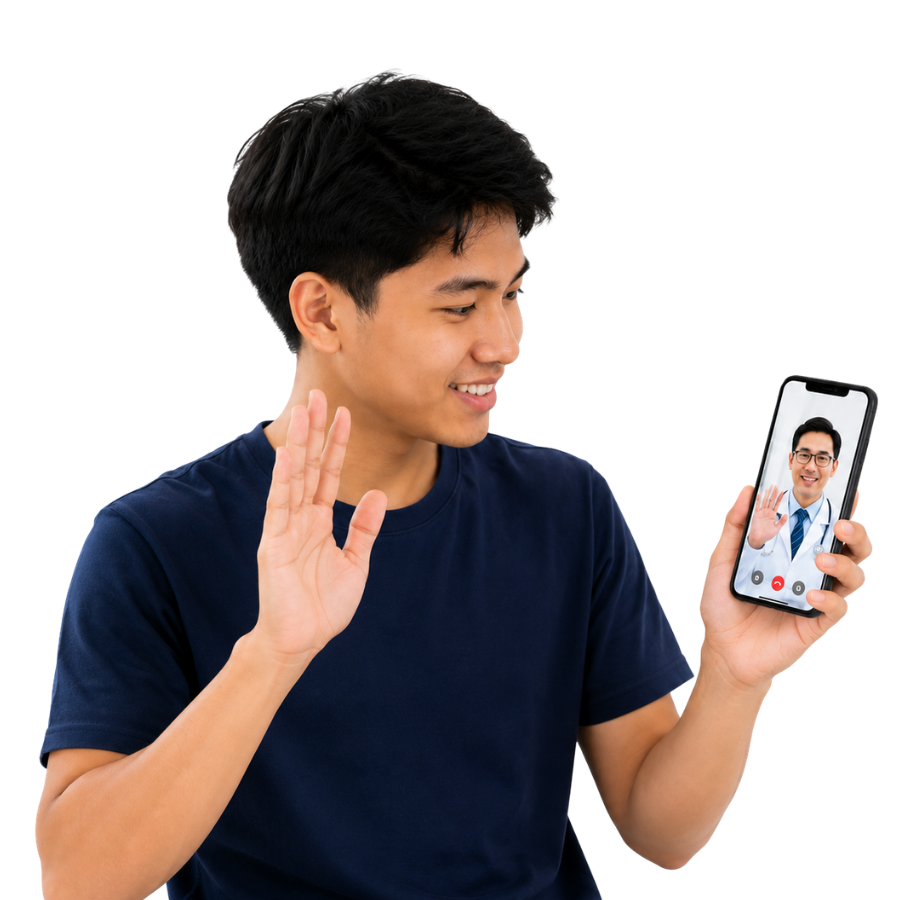
Telemedicine lets you consult a Singapore Medical Council (SMC)-registered doctor by secure video instead of travelling to a clinic. When it is used for the right problems, you can be assessed, receive advice, get a digital medical certificate (MC) when clinically justified, and have medication delivered the same day. When it is used for the wrong problems, it can delay urgent care. This guide explains how telemedicine is regulated in Singapore, when it is and is not suitable, what it costs, how subsidies work, and exactly how to prepare so you get safe, accountable care.
Everything below is grounded in Singapore's own rules: the Ministry of Health (MOH) National Telemedicine Guidelines, the Healthcare Services Act, the SMC Ethical Code, and MOH's 2024 joint telemedicine circular. Primary sources are linked throughout and listed at the end.
Teleconsult guide
Ready for a licensed video consult?
If your symptoms are suitable for teleconsult, DigitalHealth.sg connects you to an SMC-registered GP and keeps pricing transparent.
Yes. Teleconsultation is legal and is actively regulated. Since 26 June 2023, providing telemedicine is a licensable activity under Phase 2 of the Healthcare Services Act (HCSA). In law, a teleconsult is the "remote" provision of an Outpatient Medical Service, so the platform or clinic offering it must hold an MOH licence, and the doctor must be registered with the Singapore Medical Council.
Three layers of rules sit on top of each other:
The standard of care must not drop. MOH's National Telemedicine Guidelines (2015) require that "the overall standard of care delivered by the system must not be any less compared to a service not involving Telemedicine." The doctor must also be satisfied that you are suitable for a remote consult before proceeding.
The doctor's ethical duty is the same. The SMC Ethical Code and Ethical Guidelines (Section A6) state that a doctor practising telemedicine "must endeavour to provide the same quality and standard of care as in-person medical care."
Concrete operating rules apply. The Joint MOH-HSA-SMC Circular 87/2024 sets out, among other things, that first-time patients must be seen by real-time video, and that medication and MCs must not be issued through a text-only questionnaire.
How to check a provider is licensed: MOH's guidance is to look the provider up in the HealthHub directory of licensed healthcare providers. HealthHub's own advisory tells patients to be cautious of any provider not listed there. You can separately confirm an individual doctor on the SMC register. Note that providers based overseas are not licensed under the HCSA, and Singapore pharmacies will not honour their prescriptions.
How does a teleconsultation work, step by step?
The flow mirrors a clinic visit, compressed into a video workflow:
Register and verify your identity. You provide your details and the provider verifies who you are (commonly photo ID such as NRIC/EP/WP, or a Singpass link). Identity checks are a regulatory requirement, not red tape.
Join the queue and the video call. First-time patients must be seen by live video so the doctor can establish a proper doctor-patient relationship.
Be assessed. The doctor takes your history, asks about symptoms and their timeline, your medical history, allergies, current medicines, and warning signs, then forms a diagnosis and explains it.
Get a plan. This may include advice, a prescription, a referral, or — if you are assessed to be medically unfit — a digital MC. Medication can be delivered or collected.
Escalation if needed. If the problem cannot be assessed safely on video, the doctor will direct you to an in-person clinic, urgent care, or A&E. That is the system working correctly, not a failed consult.
Because the doctor cannot listen to your chest, feel your abdomen, or take your own vital signs, the quality of your history carries more weight. Specifics help: instead of "fever," give your actual temperature, when it started, whether it responds to paracetamol, and whether there is breathlessness, chest pain, rash, or persistent vomiting.
When is teleconsultation suitable?
Teleconsults work best for problems that are common, recent, and not severe — where a good history and a video look are enough to make a safe first decision. In Singapore, they are widely used for:
Some symptoms need hands-on assessment or emergency care. Do not rely on a video call for these — call 995 or go to the nearest A&E:
Chest pain, severe or sudden breathlessness.
Stroke-like symptoms — face drooping, arm weakness, slurred speech (act F.A.S.T.).
Severe or worsening abdominal pain, or vomiting blood / blood in stool.
Fainting, confusion, a first or prolonged seizure.
Heavy or uncontrolled bleeding, or major injury.
A baby or young child who is very drowsy, dehydrated, or has a high fever.
Thoughts of self-harm or suicide — call the Samaritans of Singapore (SOS) at 1-767, or go to A&E.
The rules anticipate this. MOH's 2024 circular requires providers to define when teleconsultation is inappropriate, naming examples such as conditions that cannot be assessed remotely (it cites suspected stroke or pneumonia) and patients who cannot be served safely on video. If a doctor ends your consult and sends you in person, they are following that requirement.
There are also limits on what can be prescribed remotely. Under Circular 87/2024, licensed providers must keep clinical protocols identifying medicines that should not be prescribed by telemedicine, or only with caution — including controlled drugs and medicines with addictive potential (codeine-containing products, opioids, benzodiazepines and other hypnotics/sleeping pills), medicines with significant interactions (such as PDE-5 inhibitors for erectile dysfunction), and medicines that need in-person teaching (such as insulin or inhaler technique). So a teleconsult is not the route for sleeping pills or strong painkillers.
Situation
Best channel
Why
Cough, cold, sore throat, mild fever
Teleconsult
Manageable with history, a video look, and symptom relief.
One day of diarrhoea, still able to drink
Teleconsult
Doctor can gauge dehydration risk and advise or escalate.
Stable chronic-disease follow-up / repeat meds
Teleconsult
Suitable if you have been seen in person recently (see subsidy rules below).
Ear pain, deep wounds, anything needing examination
Clinic
Needs physical examination or a procedure.
Chest pain, breathlessness, stroke signs
Call 995 / A&E
Needs urgent physical assessment and monitoring.
Request for sleeping pills or strong painkillers
In-person review
Controlled / addictive medicines are restricted on telemedicine.
For a private, on-demand GP teleconsult (the kind you use for flu, cough, or an MC), expect the consultation fee alone to fall roughly in the $10 to $25 range, with medication and delivery usually charged on top. Prices vary by provider, time of day, and what is bundled in, so always check the provider's live pricing page — the figures here were last reviewed on 11 June 2026.
At Digital Health, the teleconsult fee is $15 nett. That covers the GP video consult; a DigiMC is issued only when medically appropriate, and is not a separate purchase. Medication is charged as used, and same-day delivery starts from $8 (with a faster express option for an additional fee).
When comparing providers, look past the headline number and check what it actually includes:
Consultation fee — the doctor's time and assessment. Confirm it is for a live video consult with an SMC-registered doctor.
Medication — usually charged separately, by what is dispensed. For many viral illnesses, rest and fluids are the main treatment, so you should not be pushed to buy medicine you do not need.
Delivery — varies by location, timing, and urgency; express slots cost more.
Medical certificate — a clinical decision, never a guaranteed add-on you can "buy."
After-hours / weekend / public-holiday loading — some providers charge more outside office hours; ask before you start.
A very low headline price is not always cheaper overall once delivery, support quality, and reliability are factored in. We break this down in our guide to what affects online doctor consultation cost.
Can you use MediSave or CHAS for a teleconsult?
For a typical acute teleconsult — a cold, cough, or sick-day MC — the answer is no. Government subsidies do not cover acute video consults; as the official CHAS FAQ states, "the time-limited CHAS subsidies will not cover video consultations for acute conditions, such as common cold or cough," and you would need an in-person visit to use CHAS Acute subsidies. So most on-demand teleconsults are paid privately at the full fee.
There is one important exception — chronic-disease follow-up. Since 1 December 2023, CHAS Chronic subsidy and MediSave can be used for video consultations for the regular follow-up of all chronic conditions under the Chronic Disease Management Programme (CDMP). The conditions attached to this are strict:
It applies to follow-up of an existing chronic condition (for example diabetes, hypertension, high cholesterol), not first consults or acute illness.
You must have had at least one in-person consultation with that medical practitioner within the last 12 months, so they can confirm you are suitable for video follow-up.
It must be a video consult — phone calls, text, or email do not qualify.
Only providers that have completed MOH's telemedicine training and are listed for this can claim; these clinics appear tagged "(Remote)" in the HealthHub directory.
MediSave use under CDMP is capped (up to $500–$700 per patient per year depending on your conditions), with a 15% cash co-payment that is waived at your enrolled Healthier SG clinic.
How do digital MCs and medication delivery work?
A medical certificate is a doctor's professional opinion that you are medically unfit for work or school — it is not a product you can buy, and a responsible provider will never guarantee one before assessing you. When justified, teleconsult MCs are commonly short (often 1–2 days) because many minor illnesses settle quickly; persistent or repeated need for MCs is a signal to be reviewed in person.
Most Singapore clinics now issue a DigiMC, the national digital medical certificate built by GovTech. You receive an SMS with a unique link, unlock it once with your date of birth (no login needed), and forward that link to your employer. Employers confirm it is genuine by checking that the link sits on the mc.gov.sg domain and that it shows the doctor's name in block letters with their MCR number; printed copies carry a QR code to verify against the original. DigiMC is used across 600+ GP clinics and all public healthcare institutions, though paper MCs remain available on request.
On medication: when medicines are prescribed, the doctor must provide medication counselling, and providers either deliver to your address or direct you to collect from a pharmacy or clinic. One safety detail worth knowing — to prevent misuse, providers generally will not hand you a digital copy of the prescription itself; the medicine is dispensed or delivered directly instead. Delivery timing depends on stock, your address, and courier availability, so flag it on the call if you need medication urgently.
How should you prepare for your teleconsultation?
A little preparation makes the consult faster and the assessment more accurate. Before you join:
Have your ID ready for identity verification (NRIC/EP/WP or Singpass).
Write down your symptoms — what, since when, how severe, what helps, and any red-flag symptoms.
List your medicines and allergies, including anything you have already tried.
Take readings and photos where relevant — your temperature, blood-pressure readings, or clear, well-lit photos of a rash.
Set up a quiet, private, well-lit space with a stable internet connection, so the doctor has a full view of your face.
Know your current location — you may be asked for it in case emergency services need to be directed to you.
Have your delivery address and payment ready in case medication is prescribed.
How do you choose a safe, accountable telemedicine provider?
Telemedicine in Singapore is only as safe as the provider behind it — and recent enforcement shows why this matters. In August 2024, MOH directed one large telemedicine clinic, MaNaDr, to stop teleconsultation services after finding what it called clinically and ethically inappropriate practices: in a single sampled month, more than 100,000 video consults lasted a minute or less (the shortest just one second) yet still ended with medication and MCs issued, and more than 1,500 patients were issued five or more MCs. MOH moved to revoke the clinic's licence (effective December 2024) and referred 41 doctors to the SMC. MOH later clarified, in April 2025, that consultation length alone is not the test — "the quality and adequacy of the medical care, and not just duration of the teleconsultation, matter."
The lesson for patients is simple: a good teleconsult takes a proper history, makes and explains a diagnosis, and keeps clear records — it is not a rubber stamp. When choosing a provider, look for one that:
Is listed in the HealthHub directory of licensed providers, and uses SMC-registered Singapore doctors you can verify on the SMC register.
Requires a live video consult, not a tick-box questionnaire, and verifies your identity.
Publishes clear pricing and explains what is and is not included.
Is honest about when teleconsults are unsuitable, and redirects you to in-person or emergency care when needed.
Provides real support if a call drops or documents or medication are delayed.
Strong telemedicine is not just fast — it is accountable. Digital Health's teleconsult service is built around proper video assessment, transparent pricing, SMC-registered doctors, and clear local care pathways, operating under MOH licence R/23M1175/MDS/004/252.
Yes. Since 26 June 2023, telemedicine is a licensable service under the Healthcare Services Act. The provider must hold an MOH licence and the doctor must be SMC-registered, and the standard of care must match in-person care. You can check a provider in the HealthHub directory of licensed providers.
How do I know if a teleconsult provider is licensed?
Search for the provider in HealthHub's directory of licensed healthcare providers, which lists all licensed providers in Singapore. You can also confirm the individual doctor on the SMC register. Be cautious of any provider not listed, and note that overseas-based providers are not licensed under Singapore's HCSA.
Can I get an MC from a teleconsult?
Yes, if the doctor assesses that you are medically unfit for work or school. An MC is a clinical judgment, not a guaranteed purchase, and teleconsult MCs are often short. Most are issued as a DigiMC, which you receive by SMS link and forward to your employer.
Can I use MediSave or CHAS for an online doctor consult?
Not for acute illness like a cold or cough — those teleconsults are paid privately. MediSave and CHAS Chronic subsidy can be used only for video consultations that are regular follow-ups of a chronic condition under the CDMP, and only if you have seen that doctor in person within the last 12 months at a participating "(Remote)" provider.
What can't be treated by teleconsult?
Anything needing a physical examination or emergency care — chest pain, severe breathlessness, stroke-like symptoms, severe abdominal pain, heavy bleeding, major injury, a very unwell child, or thoughts of self-harm. Controlled and addictive medicines (such as strong painkillers, sleeping pills, and benzodiazepines) are also restricted on telemedicine.
How much does a teleconsult cost in Singapore?
For a private GP teleconsult, the consultation fee is typically around $10–$25, with medication and delivery charged separately (figures reviewed June 2026; always check the provider's current page). At Digital Health the consult fee is $15 nett, with a DigiMC issued only when medically appropriate.
How is a digital MC (DigiMC) verified by my employer?
Your employer checks that the MC link is on the mc.gov.sg domain and that it shows the issuing doctor's name in block letters with their MCR number. Printed copies include a QR code that links back to the original online certificate.
Can I use a Singapore teleconsult from overseas?
You may be able to speak to a Singapore doctor while overseas, but the advice and any documents are intended for the Singapore context, and medication delivery is generally limited to Singapore addresses. Providers based overseas are not licensed under the HCSA, and local pharmacies will not accept their prescriptions.